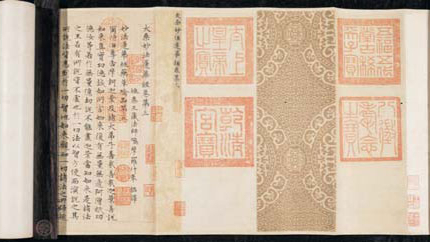
The Lotus Sutra
Introduction
The Lotus Sutra, also known as the Saddharma Pundarika Sutra, is one of the most revered and influential texts in Mahayana Buddhism. It is traditionally regarded as a discourse delivered by the Buddha towards the end of his life, which outlines the concept of universal salvation and the inherent potential for Buddhahood in all beings. The Sutra is notable for its emphasis on the idea that all paths ultimately lead to enlightenment and is a cornerstone of the teachings of Nichiren Buddhism, among others. Its influence extends beyond religious teachings, impacting culture, art, and the philosophical discourse in various Asian societies.
Historical Context and Translation
The Lotus Sutra, believed to have been composed between the 1st century BC and the 1st century AD, is one of the foundational texts of Mahayana Buddhism and among its most influential sutras. It was originally written in Sanskrit and later translated into several languages as Buddhism spread along the Silk Road to Central Asia, China, Japan, South Korea, and beyond. The Chinese translation by Kumarajiva, completed in 406 CE, is particularly significant and widely used. This translation played a crucial role in establishing the Lotus Sutra's prominence in East Asian Buddhism.
The Silk Road facilitated the spread of Buddhist texts like the Lotus Sutra, enabling cultural exchanges that enriched the religious and philosophical landscapes of the regions it touched. The Sutra’s journey along these trade routes is a testament to the dynamic interactions between diverse cultures and the dissemination of religious and philosophical ideas across Eurasia.
Key Themes and Teachings
The Lotus Sutra is renowned for several key themes that have shaped Mahayana Buddhist thought. A central tenet is the concept of Ekayana, or One Vehicle (the One Buddha Vehicle), which suggests that all teachings ultimately lead to the same goal of enlightenment. This inclusivity is a defining feature of the Sutra, promoting the idea that all beings possess the potential to achieve Buddhahood.
Another significant theme is the use of parables and allegories, such as the Parable of the Burning House and the Parable of the Lost Son, which convey profound spiritual truths through accessible narratives. These stories illustrate the compassionate nature of the Buddha and the transformative power of faith and practice.
The Sutra also introduces the concept of the eternal Buddha, suggesting that the Buddha's life and teachings transcend historical time, emphasizing a cosmic Buddha who is always present and accessible to practitioners.
Influence on Buddhist Practice
The Lotus Sutra has had a profound impact on Buddhist practice, particularly in its encouragement of devotion and the recitation of its text as a means of attaining enlightenment. In Nichiren Buddhism, the chanting of the title of the Sutra, Nam Myoho Renge Kyo, is a central practice believed to embody the essence of the Buddha's teachings and to unlock innate potential.
The Sutra's message of universal salvation has inspired numerous Buddhist movements and sects, emphasizing faith, practice, and the inherent dignity of all life. It has also been instrumental in the development of the T'ien-t'ai (Tendai in Japan) and Zen schools, influencing their doctrinal interpretations and meditation techniques.
Cultural and Artistic Legacy
Beyond its religious significance, the Lotus Sutra has left a lasting cultural and artistic legacy. Its themes and stories have inspired countless works of art, literature, and performance throughout Asia. From intricate paintings and sculptures in Buddhist temples to literary adaptations and theatrical performances, the Sutra's influence is pervasive.
In China, Japan, and South Korea, the visual and performing arts have drawn heavily from the Lotus Sutra, depicting its parables and teachings in diverse mediums. The Sutra's artistic representation has often served as a tool for religious instruction and a means of conveying its profound teachings in a compelling and accessible manner.








